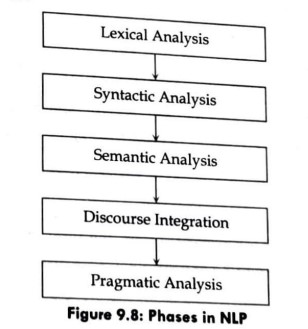
Explain the phases NLP.
1. lexical Analysis and Morphological: The first phase of NLP is the Lexical Analysis. This phase scans the source code as a stream of characters and converts it into meaningful lexemes. It divides the whole text into paragraphs, sentences, and words.
2. Syntactic Analysis (Parsing): Syntactic Analysis is used to check grammar, word arrangements, and shows the relationship among the words. Example: Arjun goes to the Radha In the real world, Arjun goes to the Radha, which does not make any sense, so this sentence is rejected by the Syntactic analyzer.
3. Semantic Analysis: Semantic analysis is concerned with the meaning representation. It mainly focuses on the literal meaning of words, phrases, and sentences.
4. Discourse Integration: Discourse Integration depends upon the sentences that proceed it and also invoke the meaning of the sentences that follow it.
5. Pragmatic Analysis: Pragmatic is the fifth and last phase of NLP. It helps you to discover the intended effect by applying a set of rules that characterize cooperative dialogues. For Example: "Open the door" is interpreted as a request instead of an order.


great
ReplyDeleteNatural Language Processing (NLP) is a field of Artificial Intelligence that enables machines to understand, interpret, and generate human language. The NLP process typically follows a series of structured phases that transform raw text into meaningful insights.
DeleteNLP Text Generation Projects For Final Year
🔹 1. Text Acquisition
This is the initial phase where raw text data is collected from sources such as documents, websites, social media, or speech (converted to text).
🔹 2. Text Preprocessing
Raw text is cleaned and prepared for analysis. This includes:
Tokenization (splitting text into words/sentences)
Removing stop words (e.g., “the”, “is”)
Stemming and lemmatization
Lowercasing and noise removal
👉 This phase ensures the data is consistent and usable.
🔹 3. Lexical Analysis
In this stage, the text is analyzed at the word level:
Identifying word structures
Understanding vocabulary
Assigning basic meanings
🔹 4. Syntactic Analysis (Parsing)
This phase examines the grammatical structure of sentences:
Part-of-Speech (POS) tagging
Sentence parsing
Checking grammatical correctness
👉 Helps the system understand how words are arranged.
🔹 5. Semantic Analysis
Here, the focus is on understanding meaning:
Word sense disambiguation
Named entity recognition
Context interpretation
👉 Converts text into meaningful representations.
🔹 6. Pragmatic Analysis
This advanced phase interprets context and intent:
Understanding sarcasm, tone, and intent
Considering real-world knowledge
🔹 7. Feature Extraction / Representation
Text is converted into numerical form for machine learning:
Bag of Words (BoW)
TF-IDF
Word embeddings (Word2Vec, GloVe)
🔹 8. Modeling & Prediction
Machine learning or deep learning models are applied:
Classification (sentiment analysis)
Translation
Chatbots
🔹 9. Evaluation & Output
The final phase evaluates model performance using metrics like:
Accuracy
Precision & Recall
F1-score