What is meant by strategic planning? Explain its formulation and implementation.
Strategic planning is an important component of strategic management. Strategic management is a comprehensive and ongoing management process, aimed at formulating and implementing effective strategies. It is the way of approaching business opportunities and threats. Strategic planning is an organization's process of defining its strategy, or direction, and making decisions for allocating its resources to pursue the given strategy. Strategic management is that set of managerial decisions and actions which determines the long-run performance of an organization. Formulation of Strategic Plan
Strategic plan provides a long-term road map to the organization. Hence, it must be prepared systematically and scientifically. The following steps are normally adopted while formulating a strategic plan.
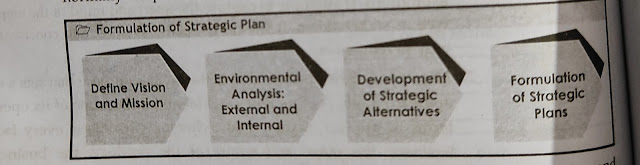
1. Define vision and mission: In the first step of strategic plan, vision and mission of the organization are developed.
Vision: Vision is a picture of what an organization wants to be and, in broad terms, what it wants to ultimately achieve. Thus, a statement gives shape to an organization's intended future. In other vision words, a vision statement points the direction where an organization would eventually like to be in the future. It reflects a firm's value and aspirations. It attempts to capture the heart and mind of the employees as well as stakeholders. It should be relatively short and concise, making it easy to remember.
Mission: A mission statement is the unique purpose that sets a company apart from others of its types and identifies the scope of its operations in terms of product, market, and technology. It reflects every facet of the business: the range and nature of the products the business offers, pricing, quality, service, marketplace position, growth potential, use of technology, and the relationships with the customers, employees, suppliers, competitors and the community. It also helps to clarify the scope and objectives of the business.
2. Environmental analysis (External & internal): In the second step of the strategic planning process, analysis of the business environment is done. It helps to collect information about the nature and trend of environment.
Analysis of external environment: It involves the analysis of the task and remote environment of an organization. The task environment is relatively closer to the business and formed by customer, supplier, shareholders, and trade unions. The remote environment consists of political, legal, economic, socio-cultural, technological, environmental and global components. The analysis of the external environment of a business results in identification of opportunities or threats.
Analysis of internal environment: It involves the analysis of resources, organizational policy, organizational structure, and objective to assess the relative strength and weakness of the business.
3. Development of strategic alternatives: After analysis of both internal and external environments, SWOT (Strengths, Weaknesses, Opportunities and Threats) analysis is conducted so that possible strategic alternatives are developed. They may be market development, product development, and diversification.
4. Formulation of strategic plans: This is the last step of strategic planning process. It involves evaluating each alternatives and selecting a particular strategy from among various strategic alternatives. Each alternative is evaluated on ground of suitability, acceptability and feasibility.
IMPLEMENTATION OF STRATEGIC PLAN
implemented effectively which is again equally challenging job. Success or failure of an organization Strategic plan must be formulated to achieve the predetermined goals. For this, formulated plan must be depends on the effective implementation of strategic plan. Unless implemented the plan, it is meaningless to formulate them. Therefore, managers should be aware to implement the plan timely and accurately. The following points are important for the effective implementation of plan:
Successful implementation depends on organizational structure.
- Organizational activities should be properly divided, organized and coordinated. Organizational structure should be matched with strategy.
- Goals should be determined clearly in qualitative figures as far as possible.
- Strategy must be institutionalizing. It should be transferred into actions, plans, policies, procedures and rules which will be helpful for decision makers.
- Policies and procedure are powerful tools for implementation of strategic plan. Annual budget and targets should be defined clearly.
- There must be open and two-way communication system between different levels of management and employees.
- Performance based rewards and incentives also help implement the plan effectively.
- Researches and actions should be matched clearly which is an essence of implementation.
- Maximum number of managers and employees should be involved in formulating and implementing processes.
- Working condition and organizational climate should be supportive for successful implementation.
- Proper technology is essential for implementation of the plans. Leadership plays vital role in effectiveness of the plans. It must be supportive and motivating to the employees.
Reality: Whatever may be the quality of the plans, it is judged how far it is implemented and predetermined goals are achieved.
Comments
Post a Comment